


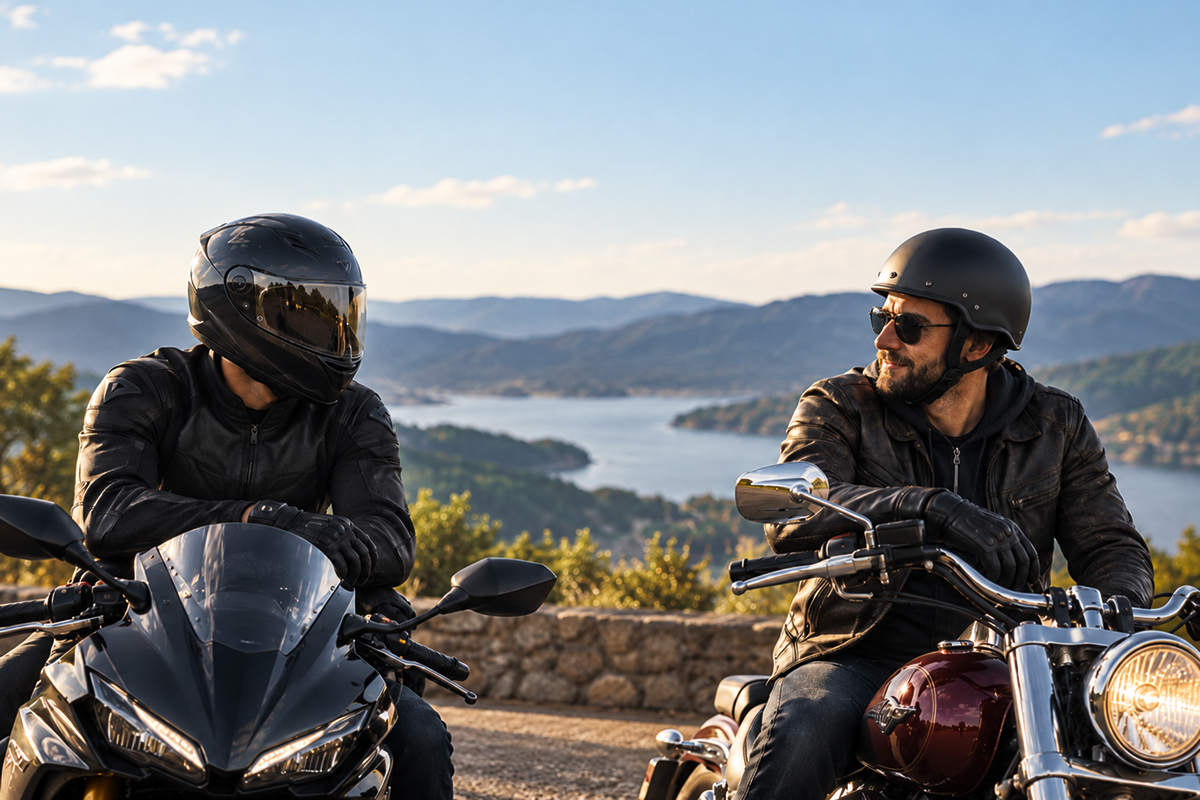
Picking a motorcycle helmet is not just about what looks good. It comes down to how you actually ride.
Not how you plan to ride someday. Not the dream route you have mapped out. The regular rides you are doing now, on the roads you know, in the conditions you actually deal with in Kansas City.
Because the helmet that fits your style in a parking lot and the helmet that gives you the protection you need on I-29 at 65 mph are sometimes very different things. This post walks through the main helmet styles, what each one covers, and how to figure out which type makes sense for the riding you do.
The Main Helmet Styles
Full-Face Helmets
A full-face helmet wraps around your entire head including your chin and jaw. The chin bar is the hard shell piece at the front that most open-face and half shell helmets leave out. A face shield clips or slides in place to block wind, bugs, road debris, and rain.
The chin and jaw area takes a significant hit in a large percentage of motorcycle crashes. That is the part of your head a half shell or open-face helmet does nothing for. A full-face is the only common street helmet style that protects it.
Full-face helmets also tend to be noticeably quieter at highway speeds because the chin bar reduces the wind noise that gets in around your face and neck. If you are doing any kind of regular miles on the highway, that adds up over the course of a ride.
They come in every price range and in styles that work for cruisers, touring bikes, and sport bikes. Low-profile full-face helmets have come a long way in terms of look, and a lot of riders are surprised by how much the options have opened up.
Best for: Highway riding, commuting on busy roads, long-distance trips, anyone who wants the most coverage available.
Half Shell Helmets (Skull Caps)
Half shell helmets, sometimes called skull caps or brain buckets, cover the top portion of your head and not much else. They sit low on the skull, leaving your face, ears, and chin completely open to the wind.
They are light, minimalist, and extremely popular in the biker and cruiser community. There is a reason for that. The low-profile look works with the style of a lot of bikes, and on a hot Kansas City summer day, there is nothing between your face and the air moving past you.
The trade-off is coverage. A half shell does not protect your face or chin at all. If you go down and your face hits the pavement or another vehicle, the helmet is not there for that part of the impact.
Riders who wear half shells are generally making a considered choice about the kind of riding they do. Short local trips, familiar roads, lower speeds. That is a personal decision every rider makes for themselves.
Best for: Short local rides, cruiser and biker style, riders who prioritize airflow and a clean look.
Open-Face and 3/4 Helmets
Open-face helmets, also called 3/4 helmets or polo-style helmets, sit between a full-face and a half shell. They cover your head and wrap down around the sides and back further than a half shell, but the front stays open at your chin and face.
Most open-face helmets can be paired with a snap-on shield or riding goggles for sun and wind protection. The shell comes down further around your head than a skull cap does, which gives you more coverage overall, but the chin is still unprotected.
For city riding, cruisers, and retro builds, the open-face is a popular middle ground. More covered than a half shell, less enclosed than a full-face.
Best for: City riding and short commutes, cruisers and retro builds, warm weather riding where airflow matters.
Coverage Comparison
Here is how the main styles stack up side by side:
| Helmet Style | Coverage | Chin Protection | Best For |
| Full-Face | Full head and face | Yes | Highway, commuting, sport riding |
| Modular / Flip-Up | Full head and face (chin lifts) | Yes (when closed) | Touring, mixed riding, commuters |
| Open-Face / 3/4 | Head and cheeks | No | City riding, cruisers, warm weather |
| Half Shell / Skull Cap | Top of head only | No | Short local trips, biker style |
One thing worth knowing: more coverage does not mean sacrificing style. Full-face helmets come in matte finishes, low-profile shells, and vintage-inspired designs. The options are a lot wider than most riders expect until they actually look.
Which Style Is Right for Your Riding
If You Ride the Highway or Commute Regularly
Go full-face. Speed changes the equation on impact, and wind fatigue over a long commute is real. A full-face helmet with decent ventilation will serve you significantly better than anything else for regular highway miles in and around Kansas City.
If You Are a Weekend Cruiser or Biker
Half shell and open-face helmets are common in the cruiser community for good reason. If you are mostly doing local roads at lower speeds, the coverage trade-off might make sense for your riding. Just be honest with yourself about where you actually end up riding versus where you planned to. A quick errand has a way of turning into a longer run.
If You Want Protection Without the Closed-In Feel
Modular helmets, also called flip-up helmets, give you full-face protection when the chin bar is down and the option to flip it up when you are stopped or cruising at low speeds. A lot of touring and commuting riders run modulars specifically because you get most of the protection of a full-face with more flexibility when you are off the bike.
A Note on DOT Certification
Whatever style you choose, make sure the helmet carries a DOT certification. Missouri law requires all motorcycle riders to wear a DOT-certified helmet. A helmet without a DOT label is not legal for road use in Kansas City, regardless of how it looks or what it is labeled as.
Some helmets sold as novelty or costume pieces are built to look like real motorcycle helmets but have not been tested to any safety standard. The DOT label on the back of the helmet is what separates a certified helmet from a decorative one.
We have a full breakdown of what DOT certification actually means, how it differs from ECE 22.06, and how to spot a fake label in our post: DOT vs ECE Helmet Certification: What the Ratings Actually Mean
Getting the Right Fit Matters as Much as Style
Once you know which style works for your riding, the next step is making sure the helmet fits your head correctly. Helmet sizing varies between brands, and the shape of the shell matters as much as the size number.
A helmet that is too loose can move in a crash. One that is too tight causes headaches and makes longer rides miserable. And a helmet that fits one rider perfectly may not work the same way for someone with a different head shape.
We walk through the full fit process in our post: How to Check Motorcycle Helmet Fit Before You Ride, including how to measure your head, what proper fit feels like, and how to tell when a helmet is not right for you.
Come In and Try Them On
At Renegade Classics Kansas City, we carry full-face, open-face, half shell, and modular helmets from brands including LS2, Daytona, Badass Helmets, and Microdot. Every helmet we carry is DOT certified.
Helmet fit varies a lot between brands and shell shapes. The only reliable way to know which one works for your head is to put it on and check the fit in person. Our staff can walk you through what to look for so you leave with something that actually fits and works for your riding.
See our full helmet selection, or stop in at 6569 N. Oak Trfwy, Kansas City, MO 64118.
We are open Monday, Tuesday, and Friday 11AM to 6PM, Saturday 9AM to 6PM, and Sunday 11AM to 6PM. Closed Wednesday and Thursday.
We are a physical store only. No online sales or shipping. Call us at (816) 237-0509 if you have questions before you visit.
